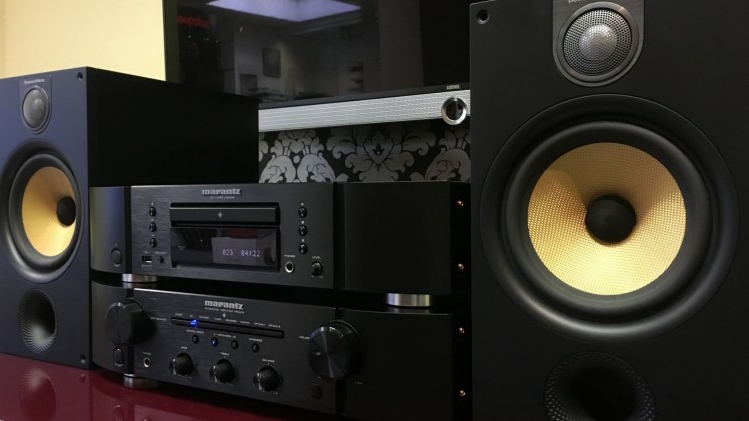
For some people around, amplifiers are all alike, they are just metal box which work was to make your speaker produce sound. But, is it that true? Are all amplifiers the same and can work with all speakers around to produce sound? Well obviously the answer is no, and if you do mindlessly pair amplifiers and speakers then the result is quite.., not good for sure.
So how do we pair our speaker and amplifier? What are the things we need to check to ensure those equipment will last long and would produce desirable sound?
Three Things That You Need To Know
Basically, there are only three things that you need to ensure in pairing your amplifier and speaker, and those things are the impedance, power, and sensitivity. So what are those things? To answer that let’s have little review.
Impedance
Impedance is a electrical resistance of your component, usually, you can find this number with the Ω symbol beside it, indicating that the number is the measure of resistance represented in ohms. We can just check the specs sheet provided by the manufacturer to know the impedance of either amplifier and speaker.
So why is it important? It is important to know for us to be certain that your speaker is compatible to the amplifier, vice versa. The focal point of this is that, it is much safer to connect speaker with high impedance (let’s say 8 ohms) to amplifier that capable of operating with a lower impedance (4 ohms or 6 ohms). What you should not do is to connect amplifier working on high impedance to speaker with lower impedance because it might result to overheating your amplifier.
Power
Power is a rate at which electical energy is converted to other forms of energy such as kinetic, heat, electromagnetic, etc, and expressed as wattage (W). Wattage in speakers means how much power it can handle. On the otherhand, wattage in amplifiers means how much power it produce or putting out.
Most of the specs sheets provides references for both Continuous Power and Dynamic Power. Continuous Power signifies measure of power that your speaker can handle or your amplifier can output in normal operation. On the otherhand, Dynamic Power is the peak power that your speaker can handle or amplifier can produce.
In pairing your amplifier and speaker, you must pay attention to Continuous Power or wattage your amplifier is putting out in normal operation and stack them up against the recommended power that your speaker can handle for safety, and remember, too much power-feed to your speaker can also burn the voice coil, thus damaging your speaker.
Sensitivity
Sensitivity is another factor to remember in pairing your speaker and amplifier, though this thing focuses much more to speakers rather than amplifiers because sensitivity is the measure of loudness your speaker produce in 1 meter per 1 watt. For example, if your speaker sensitivity rated (89dB/1m) it means that it produces loudness of 89dB in 1 meter with 1 watt of input. I guess most of you are baffled as to why we needed more power for supplying our speaker if 1 watt is sufficient to produce loudness of 89dB in 1 meter? Well, techinically if you want to add 3dB of loudness you needed twice the power it originally needed, for example, if have original loudness of 89dB per 1 watt, you need 2 watts to increase it to 92dB, 4 watts to increase it to 95dB, 8 watts to increase it to 98dB and so on and so forth. You also need to remember that per doubling the distance the loudness is reduce by 6dB, so if your speaker has a sensitivity of 89dB in 1 meter, in 2 meters loudness will reduce to 83dB, in 4 meters loudness reduces to 77dB, etc.
 WittyTech